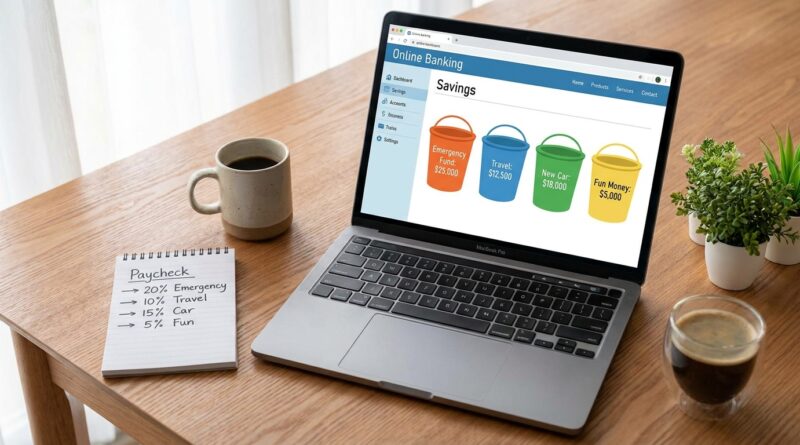
The ‘Goal-Guard’ Habit: Use Separate High-Yield Savings Buckets So You Stop Raiding Your Own Goals
You are not bad at saving. You are probably just asking one savings account to do too many jobs at once. That is why the balance keeps bouncing up and down. One week it is your vacation fund. The next week it is covering a surprise car repair, a school fee, or a “just this once” purchase. After a while, everything in that account starts to feel available, even money you meant to protect. That gets frustrating fast.
The fix is simple. Stop using one big catch-all pile. Start using multiple high yield savings accounts for different goals, or one account with clearly labeled buckets if your bank offers that feature. Give each dollar a job before life tries to steal it. Your emergency fund should not be fighting your travel fund, and your house down payment should not be sitting next to weekend spending money. A little separation creates a lot more clarity, and clarity makes it much easier to leave your long-term savings alone.
⚡ In a Hurry? Key Takeaways
- Using multiple high yield savings accounts for different goals helps you stop dipping into money meant for bigger plans.
- Set up separate buckets for emergency, short-term fun, and long-term goals, then automate transfers into each one.
- This works best when your emergency fund stays easy to reach, but your goal money is clearly labeled and mentally off-limits.
Why one big savings account keeps failing you
On paper, one high-yield savings account sounds tidy. One login. One balance. One decent APY.
In real life, it gets messy.
When all your savings sits in one place, every expense starts to look equally important. A friend’s wedding trip, a higher electric bill, holiday shopping, a dentist visit. It all comes from the same pool. So instead of making one clear decision, you end up making a dozen tiny ones. That drains your money and your willpower.
The problem is not just spending. It is confusion. If you cannot tell at a glance which dollars are truly untouchable, you will keep treating all of them like maybe-spendable money.
What the “Goal-Guard” habit looks like
The Goal-Guard habit means splitting your savings by purpose, not just by bank.
You can do that in two ways:
Option 1: Multiple separate accounts
You open different high-yield savings accounts for different jobs. For example:
- Emergency Fund
- Travel Fund
- Home Down Payment
- Annual Bills Fund
- Fun Money
Option 2: One account with labeled sub-accounts or buckets
Some banks let you create savings buckets inside one account. Same idea, less account juggling.
Either setup works. The key is that your money is no longer one blurry number.
How this changes your behavior fast
This is less about banking and more about human nature.
When you see a single savings balance of $8,000, it is easy to tell yourself you can grab $600 for something “urgent.” When that same money is split into:
- $4,000 Emergency Fund
- $2,000 House Fund
- $1,200 Travel Fund
- $800 Fun Fund
you pause. That pause matters.
Now you can see the real tradeoff. You are not just taking $600 from savings. You are taking it from your trip, your future home, or your emergency cushion. That little bit of friction protects your goals.
Start with three buckets, not ten
You do not need a giant spreadsheet and twelve accounts on day one. Keep it simple at first.
1. Emergency bucket
This is for actual surprises. Car repairs. Medical bills. Last-minute travel for family. Job loss support.
This money should be easy to access and boring to look at. It is not there to be inspiring. It is there to keep life from blowing up your budget.
2. Planned life bucket
This is for expenses you know are coming, even if the exact date is fuzzy. Insurance premiums, holidays, birthdays, back-to-school costs, annual subscriptions.
This bucket is a game changer because it stops predictable expenses from pretending to be emergencies.
3. Joy bucket
This is your guilt-free spending money for things that make life fun. Travel. Concerts. Weekend getaways. A nicer hotel. Whatever matters to you.
This part is important. If every dollar is locked down for serious adult purposes, you are more likely to raid your savings out of frustration. A joy bucket gives you room to enjoy life without wrecking bigger plans.
How to set up multiple high yield savings accounts for different goals
Here is the low-friction version.
Pick your bank setup
Choose a bank that either offers good sub-accounts or makes it easy to open more than one savings account. A great APY is nice, but ease of use matters too. If the app is confusing, this habit will not stick.
Name each account clearly
Do not label an account “Savings 2.” That tells your brain nothing.
Use names like:
- Emergency Only
- 2026 Vacation
- House Down Payment
- Car Repairs and Maintenance
- Fun Money
The more obvious the name, the harder it is to pretend the money is for something else.
Automate contributions right after payday
This is the part that makes the system run itself.
Even small automatic transfers work. Try something like:
- $100 per paycheck to emergency
- $75 to travel
- $150 to house fund
- $40 to annual bills
The goal is not perfection. The goal is consistency.
Keep one bucket intentionally spendable
This is your release valve. If everything feels forbidden, you will eventually crack and pull from the wrong account.
Give yourself one bucket that is safe to use. Then enjoy it without guilt.
What counts as “untouchable” money
This is where a lot of people get stuck.
Not every savings dollar should have the same rules.
Usually untouchable
- Emergency fund, except for real emergencies
- Down payment savings
- Tax savings
- Insurance deductible fund
Usually flexible
- Travel savings
- Holiday savings
- Fun money
- Upgrade funds for hobbies or home projects
If you decide this ahead of time, you avoid making emotional choices in the moment.
Why this works so well in a noisy, expensive world
Prices are up. Ads are everywhere. Every app wants your attention and your wallet.
That is exactly why this habit matters now.
It cuts decision fatigue. You do not have to keep asking, “Can I afford this?” in a vague way. You just check the right bucket.
It also gives you visual progress. Watching one generic savings number crawl upward is not very exciting. Watching your “Italy Trip” fund hit 60 percent or your “Home Down Payment” bucket cross a big milestone feels real.
That feeling keeps people going.
One smart combo habit
If you want to fill these buckets without feeling pinched, pair this system with small automatic savings triggers. A good example is The ‘Round-Up Rewind’ Habit: Turn Every Tiny Purchase Into High-Yield Savings Without Feeling It. It is a simple way to feed your goal buckets in the background while your regular paycheck transfers handle the heavy lifting.
Mistakes to avoid
Making too many buckets too soon
If you create fifteen categories, you may stop using the system. Start with three to five.
Using the emergency fund for non-emergencies
A sale is not an emergency. Neither is a last-minute dinner plan.
Chasing APY and ignoring usability
A slightly higher rate is not worth much if the bank makes transfers, labels, or tracking a headache.
Never reviewing your setup
Your goals change. Review your buckets every few months and rename, combine, or add accounts as needed.
A simple monthly check-in routine
Once a month, spend ten minutes doing this:
- Check each bucket balance
- See which goals are on track
- Move extra money only with purpose
- Adjust automatic transfers if your income or goals changed
That is enough. This should feel light, not like a second job.
At a Glance: Comparison
| Feature/Aspect | Details | Verdict |
|---|---|---|
| One catch-all HYSA | Simple to open, but all goals mix together and withdrawals are easy to justify | Fine for beginners, weak for goal protection |
| Multiple accounts or labeled buckets | Separates emergency, fun, and long-term money so you can see what each dollar is for | Best overall for clarity and self-control |
| Automated transfers | Moves money into each goal right after payday with almost no effort | Strongly recommended if you want the habit to stick |
Conclusion
Right now, high-yield savings rates are still strong. That is the good news. The problem is that plenty of people still use one big account that quietly gets picked apart every time something “urgent” comes up. The usual advice focuses on finding the best APY, but that misses the bigger issue. If you cannot tell which dollars are truly off-limits and which ones are safe to spend, your goals keep getting raided from the inside. Using multiple high yield savings accounts for different goals, or at least clear sub-accounts, turns saving into a practical daily system instead of a vague good intention. It protects bigger plans like travel and home down payments, gives you guilt-free money for fun, and cuts the mental clutter that makes saving feel hard. In a noisy, expensive world, that kind of clarity is worth a lot.