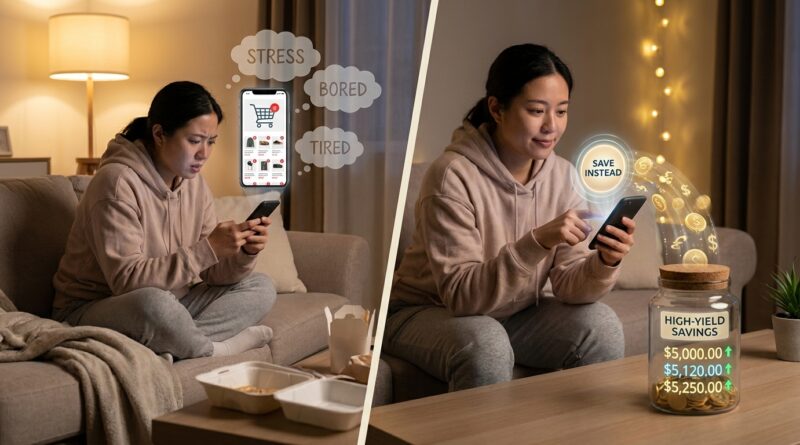
The ‘Trigger Swap’ Habit: Turn Your Worst Spending Moments Into Automatic High‑Yield Savings
You are not bad with money because you bought something dumb after a brutal Tuesday. You are human. A rough meeting, a fight at home, boredom in bed with your phone, that is often all it takes to turn “I should save more” into “add to cart.” The problem is not usually math. It is timing. Certain moments flip you into autopilot, and that autopilot spends. The good news is you can build a different autopilot. I call it the trigger swap habit. When you notice one of your usual spending moods, you do a tiny transfer to your high-yield savings account instead of, or right before, you buy. Not $500. Think $5, $10, or $25. Small enough to do without drama. Repeated often enough, it starts to change the story. You stop relying on perfect willpower and start using a system that catches you in your weakest moments.
⚡ In a Hurry? Key Takeaways
- The best high yield savings habits to stop emotional spending start with naming your personal triggers, then attaching each one to a small automatic transfer.
- Set up a rule like “after a bad workday, move $10 to savings before I open any shopping app” and make it easy to do in seconds.
- Keep the transfer small and realistic. The goal is to interrupt the spending loop, not create a savings plan so strict that you quit.
Why emotional spending keeps winning
Most people do not overspend because they forgot savings accounts exist. They overspend because emotion moves faster than intention.
You feel stressed. Or lonely. Or annoyed. Your brain wants relief now. Shopping offers a fast hit of novelty and control, even if the feeling fades by morning.
That is why endless lists of top rates only solve part of the problem. Yes, a good high-yield savings account matters. But if your usual trigger moments keep draining your checking account before you save, the rate is not the main issue.
The main issue is what happens in those 10 seconds when you want comfort, escape, or a reward.
What the trigger swap habit actually is
The trigger swap habit is simple. You identify your repeat spending triggers, then pair each one with a tiny transfer to savings.
The formula
When X happens, I move Y dollars to my HYSA.
Examples:
When I have a bad meeting, I transfer $10.
When I start late-night scrolling shopping apps, I transfer $5.
When I want a “treat” after a hard day, I transfer $15 before I buy anything.
This works for one reason. It gives your feelings somewhere to go other than checkout.
Common triggers you might recognize
You do not need a perfect budget breakdown to start. You just need honesty.
Stress spending
This is the “I deserve something after today” purchase. It often shows up after work drama, parenting overload, or a packed week.
Lonely or bored spending
This is the couch-and-phone purchase. Nothing is terribly wrong. You just want stimulation, and online shopping is right there.
Revenge spending
You had to be responsible all day. Now you want something that feels like yours. This can show up after paying bills, helping family, or handling a bunch of boring adult tasks.
Late-night low-resistance spending
Your defenses are down. Your saved cards are loaded. Your brain says yes faster at 11:47 p.m. than it does at 11:47 a.m.
How to set this up in real life
Keep this part almost boring. Fancy systems tend to die fast.
Step 1: Pick three spending triggers
Not ten. Three. Look at your last month of impulse purchases and ask, “What was going on right before I bought this?”
You will usually see patterns quickly.
Step 2: Assign a small transfer amount to each trigger
Choose an amount so small you will not argue with it.
$5 is fine. So is $8 or $12. The amount matters less than the repeatability.
Step 3: Make the transfer stupidly easy
Use your bank app. Save your HYSA as an external account. If your bank supports recurring or rule-based transfers, use them where possible. If not, manual is okay as long as it takes under 30 seconds.
If you are still choosing an account structure, you may like The 3-Bucket HYSA Habit: One High-Yield Account, Three Mental ‘Buckets,’ Zero Overwhelm. It is a smart way to keep one account from turning into one giant blob of “miscellaneous savings.”
Step 4: Put friction on your spending apps
Log out of shopping apps. Remove saved cards. Move apps off your home screen. This is not punishment. It is just giving your savings transfer a chance to happen before your impulse wins.
Examples of trigger swaps that actually work
Here are a few realistic ones.
After a rough workday
Old habit: Order takeout, browse sales, buy a little reward.
New habit: Transfer $10 to HYSA, then wait 20 minutes before buying anything nonessential.
During late-night scrolling
Old habit: Add things to cart because they are “on sale.”
New habit: Every time you open a shopping app after 10 p.m., transfer $5 first.
After an argument or emotional dip
Old habit: Buy something to change your mood.
New habit: Transfer $15 to your “peace of mind” bucket, then go for a walk, shower, or text a friend.
On payday
Old habit: Feel rich for six hours, then spend loosely.
New habit: Auto-transfer a set amount immediately, then use trigger swaps as backup protection for the rest of the week.
Why a HYSA is the right landing spot
You want the money out of easy-spend range, but not locked away like it does not exist.
A high-yield savings account is a good fit because it keeps your money separate from daily spending and pays more interest than a basic savings account at many traditional banks. That means your tiny emotional transfers can keep growing quietly in the background.
It also helps psychologically. When you see those small “bad mood” transfers stack up, you start getting proof that your worst moments no longer have to be financial setbacks.
What not to do
A few traps can make this harder than it needs to be.
Do not make the transfer too big
If every trigger costs you $50, you will skip it. Small wins beat ambitious plans you avoid.
Do not treat one slip as failure
If you bought the thing and forgot the transfer, do the transfer after. You are building a pattern, not trying to earn a perfect score.
Do not obsess over finding the perfect account first
Yes, compare rates and fees. But do not spend three weeks reading “best HYSA” roundups while doing nothing. Start with a decent account and a clear habit. Behavior usually matters more than squeezing out a tiny extra rate difference on a small balance.
Make it feel rewarding fast
This habit sticks better if you can see progress.
Name your savings buckets
“Emergency fund” is useful, but “Next calm month” or “Freedom cushion” may hit harder emotionally. That matters. You are replacing one emotional behavior with another.
Track your trigger wins
Put a note in your phone: bad meeting = $10 saved. lonely scroll = $5 saved. At the end of the month, look at how much your triggers built instead of burned.
Celebrate interrupted spending
If the transfer made you skip the purchase, count that as a double win. You saved money and avoided a regret buy.
At a Glance: Comparison
| Feature/Aspect | Details | Verdict |
|---|---|---|
| Old approach | Rely on willpower to resist emotional purchases in the moment | Usually weak under stress |
| Trigger swap habit | Pair common spending triggers with tiny, fast HYSA transfers | Simple, realistic, and repeatable |
| Best setup size | Start with 3 triggers and transfers of $5 to $25 | Most people are more likely to stick with it |
Conclusion
You do not need to become a different person to save more. You need a move that works on the exact days when you are most likely to spend for comfort. Right now, people are overwhelmed by rate headlines and “best HYSA” lists, but what actually decides their balance in six months is what they do in the 10 seconds after a bad meeting, a lonely night, or a late-night scroll. Tie those moments to a small, automatic high-yield transfer, and you turn a weak spot into a system. That is the real power of high yield savings habits to stop emotional spending. They work with real life, not against it, and they can start compounding for you today.